

Gloves for grilling, smoking and pulled meat. Which to choose and what to avoid

At the grill and smoker, a glove has three jobs at once: keep the fat out, hold together while pulling apart a multi-kilo shoulder, and pass nothing on into the food. The third job is the one most often overlooked, and it happens to have the best scientific documentation behind it. Below, concretely: which material to choose, why vinyl is a bad idea with fatty meat, and where the limit of heat resistance sits.
The short answer
For grilling, smoking and pulling meat, the best choice is nitrile gloves like Gripzzly, at a heavier weight, food-contact approved, with a gripping texture and an extended cuff. Nitrile has no plasticisers, the kind that migrate from vinyl gloves into fatty meat, no latex proteins, and its mechanical strength lets you pull meat apart without the glove tearing. Nitrile isn't protection against high heat, though, so a separate heat-resistant glove or a cotton liner underneath is needed for the hot grate.
Three different jobs, one glove
From a glove's point of view, grilling, smoking and pulling are three different tasks, and it's worth separating them before getting into materials.

Grilling is short, hot work. The hand is close to the heat source, contact with the food is often brief, and the biggest risk is burns. Here a disposable glove serves a hygiene function, not a protective one.
Smoking is long, dirty work. Ten-plus hours at the smoker means opening the chamber repeatedly, turning meat, spritzing, topping up wood chips, and contact with soot and smoker creosote. The glove goes on and off dozens of times here, so what matters is how easily it goes onto a damp hand and that it doesn't tear when pulled off.
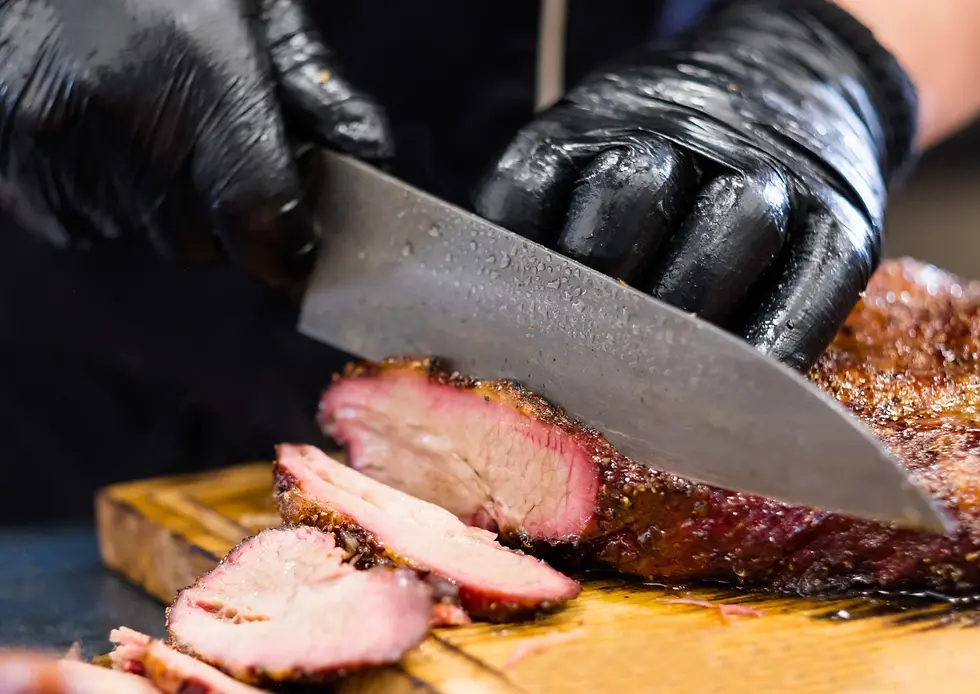
Pulling is physical, strength-based work. Pulling apart the fibres of a pork neck or shoulder means ten-plus minutes of constant pressure, tugging, and the glove rubbing against bone and cartilage, all with the hand completely coated in fat. It's the most demanding of the three tasks, and it's the one that decides which glove is worth having in the kitchen.
Why vinyl is the worst choice for fatty meat
Vinyl gloves, meaning polyvinyl chloride, are the cheapest and, because of that, the ones most often found in food service. The problem is that PVC on its own is rigid, and turning it into a flexible glove requires adding a plasticiser. The plasticiser isn't chemically bonded to the polymer, so it can migrate back out.
This isn't theory. In a study published in Food Additives and Contaminants, it was found that PVC gloves used in food preparation were a source of high concentrations of di(2-ethylhexyl) phthalate in the finished meals. Chicken contained 0.08 mg/kg DEHP raw, 13.1 mg/kg after frying, and 16.9 mg/kg after packaging. What matters for grilling practice, spraying gloves with alcohol to disinfect them increased migration further still.
A second study, on plasticiser migration from vinyl gloves, showed that migration into rapeseed oil rose with contact time and temperature, and that levels were high even at low temperature and short contact.
Grilling, smoking and pulled meat are exactly the scenario that comes out worst in these studies: lots of fat, elevated temperature, and long hand contact with the food. It's hard to find a worse combination for a vinyl glove.
Where vinyl's popularity comes from, and why it's the wrong track
Vinyl gloves win in food service on price, and nothing else. With brief contact with dry food, for example assembling a sandwich, their shortcomings matter less. Grilling and smoking are the opposite environment, though: fat, temperature and time, three factors that in migration studies all push in exactly one direction.
It's also worth noting that the problem doesn't go away when specific phthalates are phased out. The plasticiser makes up roughly a third of a vinyl glove's mass and isn't chemically bonded to the polymer, so swapping one compound for another changes the substance's name, not the mechanism by which it moves into food. A material that doesn't need a plasticiser at all solves the problem at the source.
Why not latex
Natural latex has two drawbacks for this use. The first is latex proteins, an allergen that can pass onto food served to other people. The second is purely practical: against petroleum-based compounds and organic solvents, latex performs poorly, and its strength drops on contact with fat. When pulling apart a hot, fatty shoulder, that ends with a torn glove halfway through the job.
Temperature: here it needs to be said plainly what nitrile doesn't do
No thin disposable glove is protective equipment against thermal hazards. Heat and flame resistance is covered by a separate standard, EN 407, and disposable gloves aren't tested against it. Nitrile softens and shrinks on contact with hot metal.

In grilling and smoking practice, two solutions are used, and both are correct. The first is dividing the tasks. The grate, the smoker's moving parts, cast iron and hot vessels are handled with a heat-resistant glove. The meat, marinades, rubbing and portioning are handled with a nitrile glove, whose job is to protect the food and the hand from fat, not from fire.
The second is a nitrile glove worn over a cotton glove underneath. The cotton layer gives insulation for brief contact with hot meat, while the nitrile on the outside provides a barrier against fat and keeps things hygienic. It's the standard technique for pulling meat straight out of the smoker, and the only sensible way to do it without waiting for the meat to cool.
It's also worth remembering that pulling usually happens after the meat has rested, so at a temperature noticeably lower than it came out at. The longer the rest, the smaller the heat problem, and the bigger the role the glove's own strength plays.
What the law says about food-contact gloves
The basis is Regulation 1935/2004, which requires that materials intended for food contact don't transfer their components into food in amounts that could endanger health or change the food's composition, smell or taste. On top of that comes Regulation 2023/2006 on good manufacturing practice.
There's a gap here worth knowing about when buying, though. For plastics there's a detailed Regulation 10/2011, but for rubber, meaning nitrile too, there's no harmonised European law, and national rules apply instead. In practice, Recommendation XXI of the German Federal Institute for Risk Assessment is treated as the state of the art, covering natural and synthetic rubber products intended for food contact.
The takeaway for a buyer is simple. The glass-and-fork symbol on the packaging alone isn't enough. The manufacturer should be able to produce a declaration of compliance stating which kind of food the approval covers and under what contact conditions, backed by migration testing. With fatty meat, it's exactly that testing that matters, since fat is the most demanding migration environment there is.
Why Gripzzly is the right answer for grilling and smoking
Gripzzly gloves are heavier-weight nitrile gloves (roughly 3 times thicker than standard ones), food-contact approved, and they meet all four conditions that follow from the paragraphs above at once.
Composition. Nitrile doesn't need plasticisers to be flexible, so the mechanism the studies found responsible for contaminating food with phthalates from vinyl gloves simply isn't present here. Gripzzly also contain no latex and no thiurams, which eliminates the most common allergens tied to the glove itself, for the cook and for the guest at the table alike.
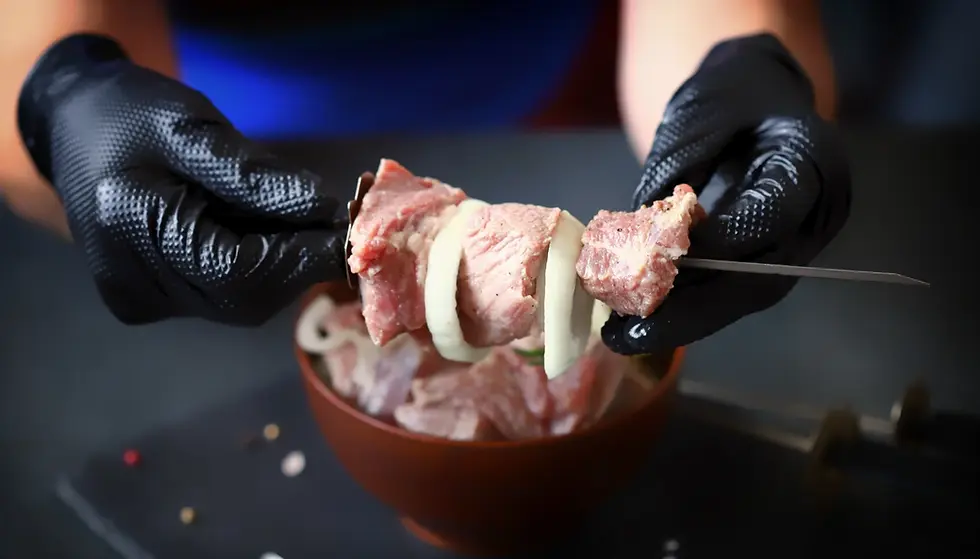
Grip. Pulling meat is work where the hand is coated in fat and still has to hold onto a multi-kilo piece. Gripzzly have a diamond texture across the whole gripping surface, which works like tyre tread and keeps grip on wet and oily surfaces. With a smooth examination glove, the shoulder slips out of your hands and ends up on the floor.
Strength. A thin examination glove is designed for brief, gentle tasks, and simply tears when pulling meat fibres apart. Gripzzly's heavier weight gives it the mechanical toughness to get through a whole shoulder in one pair, with no pauses to change gloves partway through.
Cuff. When reaching into the smoker, flipping ribs, or rubbing down large cuts, fat and marinade run down the forearm. The Gripzzly X LONG version has a 300 mm cuff, reaching high up the forearm, closing off that route of soiling.
That's why Gripzzly is what you reach for at the grill, the smoker and for pulled meat, and a cotton liner underneath for the hot grate.
The hygiene point that gets forgotten at the grill
A glove doesn't replace handwashing, it supplements it. It goes on clean, dry hands, because moisture and leftover fat under a glove create an environment that favours bacterial growth.
The most important rule, though, concerns cross-contamination. A glove that's had contact with raw meat doesn't touch the finished product, the serving board, the smoker lid, or a phone. This is where bacteria most often get transferred, not through the meat itself. When moving from raw to cooked, you change the pair, you don't wipe it on your apron.
Disposable gloves don't get washed and reused. Spraying them with alcohol, common in food service, actually increased plasticiser migration into food in the case of vinyl, so it's a practice that solves one problem and creates another.
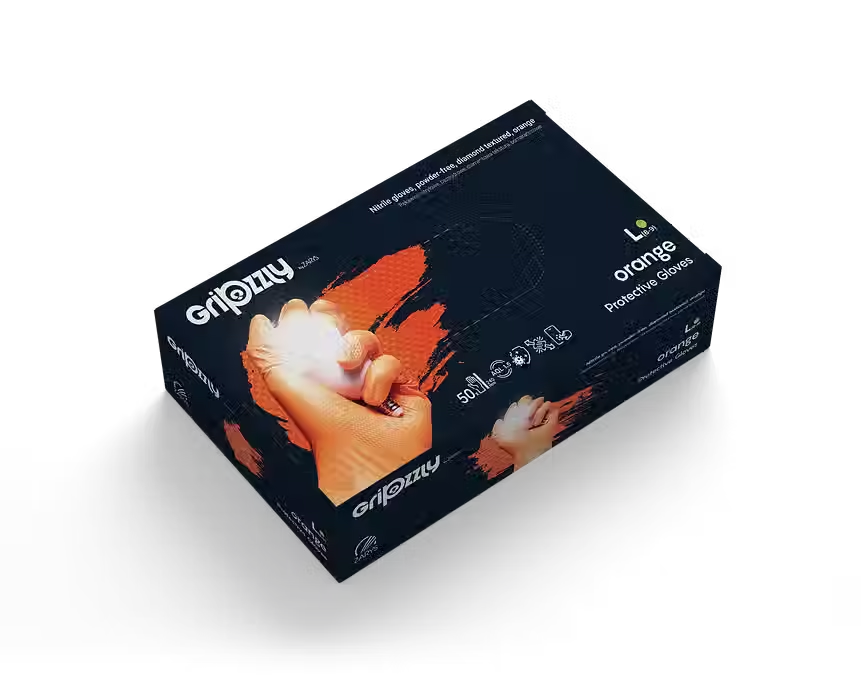
For paid work, for example at an outdoor event or in a food truck, a lighter colour than black is worth considering. Soiling doesn't show on a black glove, which is a visual plus, but it makes it harder to judge when to change it. The orange Gripzzly variant shows dirt and enforces discipline.
Frequently asked questions
Which gloves for pulling meat?
Nitrile, at a heavier weight, with a gripping texture, food-contact approved, for example Gripzzly. If the meat is still hot, they go on over a cotton glove that provides insulation.
Do nitrile gloves withstand high temperatures?
Not in the standards sense. Protection against thermal hazards is covered by EN 407, and disposable gloves aren't tested against it. Nitrile softens on contact with hot metal, which is why the grate is handled with a heat-resistant glove.
Can vinyl gloves be used for grilling?
Technically, yes, but with fatty meat it's the worst of the available choices, because plasticisers from PVC migrate into fat, and migration rises with temperature and contact time.
How can you tell a glove is food-contact approved?
By the glass-and-fork symbol on the packaging, and by the manufacturer's declaration of compliance, which states the type of food and the contact conditions. For rubber there's no harmonised EU law, so the manufacturer's document matters more here than the pictogram alone.
How many pairs of gloves does one smoking session need?
More than you'd assume. Every switch between raw and cooked product means a new pair, as does any soiling with cleaning chemicals. For an all-day smoke, a realistic count is anywhere from several to over a dozen pairs, which is why a bulk pack works out cheaper than a small box.
Sources
Tsumura Y. et al., Di(2-ethylhexyl) phthalate contamination of retail packed lunches caused by PVC gloves used in the preparation of foods, Food Additives and Contaminants, 2001: pubmed.ncbi.nlm.nih.gov
Kawamura Y. et al., Migration of plasticizers and nonylphenol from polyvinyl chloride gloves, Journal of the Food Hygienic Society of Japan, 2000, record in the US EPA HERO database: hero.epa.gov
Characterisation of Elastomers as Food Contact Materials, Part 1, Molecules, 2021 (no harmonised EU law for rubber, the role of BfR Recommendation XXI): mdpi.com
European Parliamentary Research Service, Food Contact Materials. Regulation (EC) No 1935/2004, 2016: europarl.europa.eu
Regulation (EC) No 1935/2004 on materials and articles intended to come into contact with food
Regulation (EC) No 2023/2006 on good manufacturing practice for materials and articles intended to come into contact with food
Standards cited in the text: EN 407 (protection against thermal hazards), EN ISO 374-1, ISO 21420



Comments