

Disposable gloves for children: when they make sense, and when it's better not to use them
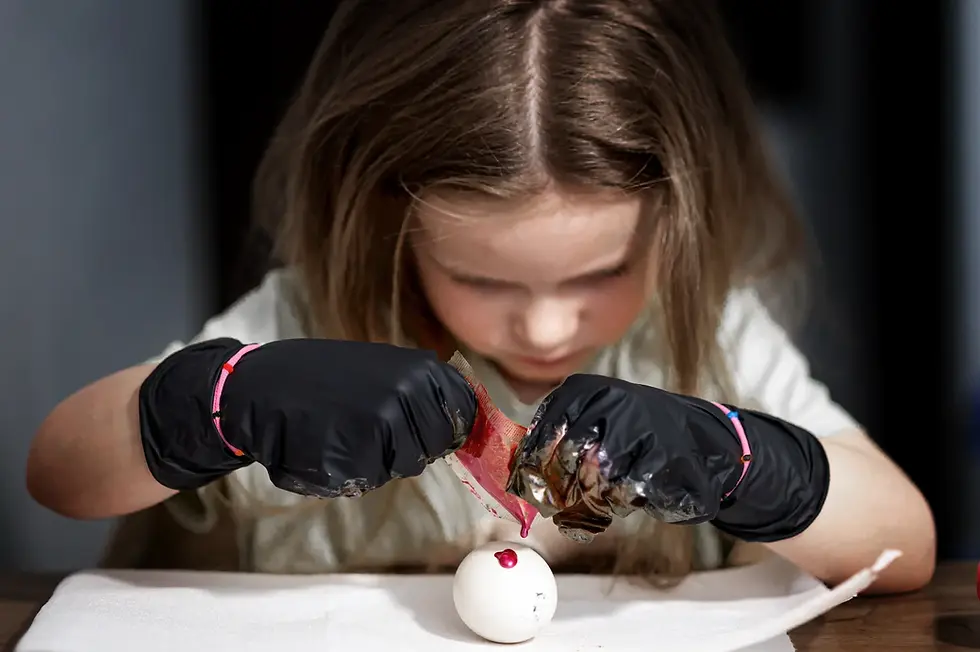
The question about disposable gloves for children looks like a simple shopping question, and in reality it hides three completely different situations. A four-year-old who wants to help wash a bike is one thing, a thirteen-year-old in a chemistry class is another, and an adult putting on gloves to look after a child is yet another.
This article separates these three cases, because only in one of them is the answer a glove in a size you can actually buy. In the other two, the sensible answer is different, and it's worth saying so plainly, rather than selling a solution that won't work.
In short
The smallest commonly available disposable glove size is S, corresponding to a hand circumference of about 17.8 cm. Below that, the range practically stops.
In a study of 304 children aged 6 to 15, the median hand circumference was 17.4 cm, just below the size S threshold. That means roughly half the children in that age range have a hand that's too small.
A glove that's too big doesn't protect worse, it just protects in appearance only. Folds at the gripping surface kill feel, loose material snags, and the child feels a safety that isn't actually there.
A disposable glove is a thin elastomeric membrane, meaning material in the same class as a balloon. For young children it's a choking hazard, not a toy.
For young children the right answer is removing contact with the substance, not protecting the child during that contact.
Three different questions hiding inside one phrase
First: an adult needs gloves for looking after a child, for changing nappies, dressing wounds, giving medication or cleaning up after an illness. This is an ordinary question about gloves for an adult, and the size is chosen for an adult's hand.
Second: a teenager needs to work in gloves during a lesson, at a workshop, fixing a bike, or dyeing hair. This is where adult sizing starts to work, and most of this article is about that.
Third: a young child is meant to do something in gloves, usually because they want to help. This is the only case where the honest answer is: a glove isn't the solution here.
A child's hand in numbers
Let's start with the data, because intuition fails here. Adults tend to assume a child's hand is simply smaller by some amount, and the difference is much bigger than it seems.
A study published in 2025 in Frontiers in Pediatrics measured the hands of 304 children aged 6 to 15. Below are the results for hand circumference, exactly the measurement glove sizing is based on.
The median matters more here than the average. It came out at 17.4 cm, and size S corresponds to a circumference of about 17.8 cm. In other words, roughly half of children aged 6 to 15 have a hand smaller than the threshold for the smallest commonly available size.
The range, meanwhile, is huge, from 14 to 23.8 cm. A child at the upper end of that range has a bigger hand than plenty of adults, while a child at the lower end won't fit anything you'll find at a wholesaler. Age is a very weak indicator here, which is why picking a size by the child's age doesn't make sense.
From what point does size S make sense
Here's the practical answer most readers came for.
The way to measure is simple. Wrap a tailor's tape measure or a piece of string around the child's palm at its widest point, excluding the thumb, and read off the result. Two minutes, one number, no more guessing.
If the result is 17 cm or more, size S will fit reasonably well. If it's clearly smaller, no adult size will work, and a different solution is needed, covered below.
And now, the thing that neatly ties the whole argument together. The situations where a child really needs a protective glove are chemistry and biology lessons, technical workshops, an art class with resins or dyes, a first-aid course, or helping out with real work in a workshop. All of these are activities for older children and teenagers, meaning exactly the group whose hands already fit into adult sizing.
Size S isn't a compromise, then, it's the right size for the applications where a glove actually makes sense.
Why a glove that's too big is worse than none
This is a claim that sounds exaggerated until you break it down.

Folds instead of contact. Excess material gathers in the palm, exactly where contact with an object is supposed to happen. The child loses feel and has to squeeze harder to hold onto anything.
Empty fingertips. A centimetre or so of slack material at the fingertips wipes out precision. With a pipette, a brush or a screwdriver, that's the difference between working and fumbling.
Snagging. Loose material catches on edges, handles and anything that sticks out. Around any moving parts, that's a hazard, not an inconvenience.
A false sense of safety. This is the most serious point of the four. A child in an oversized glove acts bolder than without one, because they see a barrier on their hand.
Meanwhile, a loose glove slides down, draws liquid in at the cuff, and tears at the first snag. Apparent protection is worse than none, because it changes behaviour without changing the risk.
The risk no size chart mentions
This part concerns the youngest children and calls for being unambiguous.
A disposable glove is a thin, sealed elastomeric membrane. In terms of material and mechanics, it belongs to the same class of objects as an ordinary balloon. Children, for that matter, treat it exactly the same way, and blow it up at the first opportunity.
The US Consumer Product Safety Commission requires latex balloon packaging to carry a warning that children under eight can choke or suffocate on an uninflated or broken balloon. Balloons accounted for roughly 38 percent of all toy-related choking deaths reported between 2001 and 2014, and most of those incidents involved children under six. The mechanism is unusually dangerous, because the flexible membrane conforms to the shape of the airway and forms an airtight seal.

Disposable gloves are personal protective equipment or a medical device. They aren't toys, they aren't subject to toy safety requirements, and nobody designed them with an eye to what a five-year-old left alone for two minutes will do with them.
Practical takeaway: gloves are kept out of the reach of young children, used ones are thrown away straight away, and blowing them up isn't innocent play, it's exactly the scenario balloon labels warn against.
When something other than a glove is needed
Workplace safety follows a hierarchy of controls, and personal protective equipment sits at the very bottom of it, after eliminating the hazard, substituting it with something safer, and engineering controls. A glove is the last line of defence, not the first.
With young children, this hierarchy solves the problem almost always at an earlier level. If a four-year-old wants to help fix a bike, the right answer isn't a glove on their hand, it's keeping them away from the grease: they get a rag and a clean part to hold, or their own separate task alongside. If a chemical is involved, the answer is preventing contact altogether, not a thinner layer between the child and the chemical.

The same logic works the other way, and it's fairly reassuring. For playing doctor, painting with poster paints, baking cookies or planting flowers, a glove isn't needed at all. Soap is enough.
What to do when the hand is smaller than S
Three honest options, in order from best.
Change the task, not the glove. In nine cases out of ten, the task can be assigned so that hand protection isn't needed at all.
Look for a product with children's sizing. Gloves designed for smaller hands exist, mainly gardening and work gloves, textile or coated. These aren't disposable gloves and don't give a chemical barrier, but for mechanical and dirty tasks they'll work better than an oversized disposable.
Don't improvise with folding and tape. A folded-over cuff creates a groove where liquid collects, and tape around a child's wrist is an idea that ends worse than it looks at the start.
Frequently asked questions
Are there nitrile gloves in children's sizes?
In a typical market range the smallest size is S, and very rarely XS. Sizes below that practically don't exist, because disposable gloves are designed as personal protective equipment for working adults, not for children.
From what age will a child fit into size S?
Age is a poor criterion, because the spread of hand sizes within the same age group is very wide. The measurement decides. A circumference of 17 cm or more means S will fit properly.
Can you give a child an adult glove and fold over the cuff?
That's not a good idea. Folding it over doesn't reduce the glove's width at the gripping surface, and it creates an extra spot where liquid collects.
Is nitrile safer for a child than latex?
Nitrile contains no natural rubber proteins responsible for an immediate allergic reaction, which matters especially for children in groups at higher risk of latex sensitisation.
Does a glove protect a child from getting dirty while playing?
Soap and water are enough for dirt. A disposable glove is a barrier against something that shouldn't be within a child's reach during play in the first place.
In closing
The smallest size of Gripzzly is S, which corresponds to a hand with a circumference of roughly 17 cm and up. In practice that means older children and teenagers, meaning the group that actually does the tasks requiring hand protection.

For younger children we don't have a solution, and there's no reason to pretend otherwise. A glove that's too big on a small hand doesn't protect, it just looks like it does, and that's a worse state than no glove at all, because it changes the child's behaviour without changing the risk.
A tailor's tape measure costs a few złoty and settles the matter in two minutes. It's worth starting there, not with the shopping cart.
Sources
Hand dimensions of children aged 6–15, sample of 304, hand circumference from 14.0 to 23.8 cm, median 17.4 cm, average 17.81 cm: Predictive analysis of dominant hand grip strength among young children aged 6–15 years, Frontiers in Pediatrics 2025, PMC11961908 (study conducted in Saudi Arabia; the values should be treated as an order of magnitude, not a norm for the Polish population)
Growth of hand dimensions with age, sample of 1,255 children aged 5–13: Hand anthropometry and its relation to grip/pinch strength in children aged 5 to 13 years, Journal of International Medical Research 2020, PMC7720326
The mandatory warning on choking and suffocation risk for children under 8, and the mechanism of the hazard: CPSC, balloon warning notice (PDF) oraz CPSC, Small Parts and Choking Hazard Labeling FAQs
The share of balloons in toy-related choking deaths, about 38 percent between 2001 and 2014: St. Louis Children's Hospital, Why are Latex Balloons a Danger to Children
A sizing system based on hand circumference and length: ISO 21420:2020 (fragment normy, PDF)
Dimensions of examination gloves from Extra Small to Extra Large: BS EN 455-2:2015, Medical gloves for single use, Part 2 (PDF)


Comments