

Gloves for UV resin 3D printing. Which to choose and how often to change them

Resin printing looks innocent enough: often a small machine on a desk, a few hundred millilitres of liquid in a vat, a finished print ready by morning. The problem is that uncured UV resin is a mixture of acrylates, meaning substances that sensitise the skin, and acrylate sensitisation is permanent and can end a hobby or a career. The glove is the basic safeguard here, and at the same time the element where most mistakes get made.
The short answer
For UV resin, disposable nitrile gloves are used (e.g. Gripzzly), not latex and not vinyl. Nitrile is the material named in safety guidelines for resin printing when it comes to contact with uncured resin, support structures, and print-washing solutions. What decides isn't the material alone, though, but thickness and discipline about changing gloves: a thin examination glove gives protection measured in tens of minutes, and in contact with isopropyl alcohol, much less. A glove is changed after every visible soiling, not at the end of a session.
Why UV resin is a problem for skin
SLA, DLP and MSLA printing resins are mixtures of acrylate monomers and oligomers along with photoinitiators. In liquid form they're irritating, and their acrylate components are among substances that sensitise skin. The mechanics of sensitisation are key here: the reaction doesn't appear on first contact, only after repeated, often unnoticed exposure. Once it occurs, it usually affects an entire group of related compounds, not one specific resin.
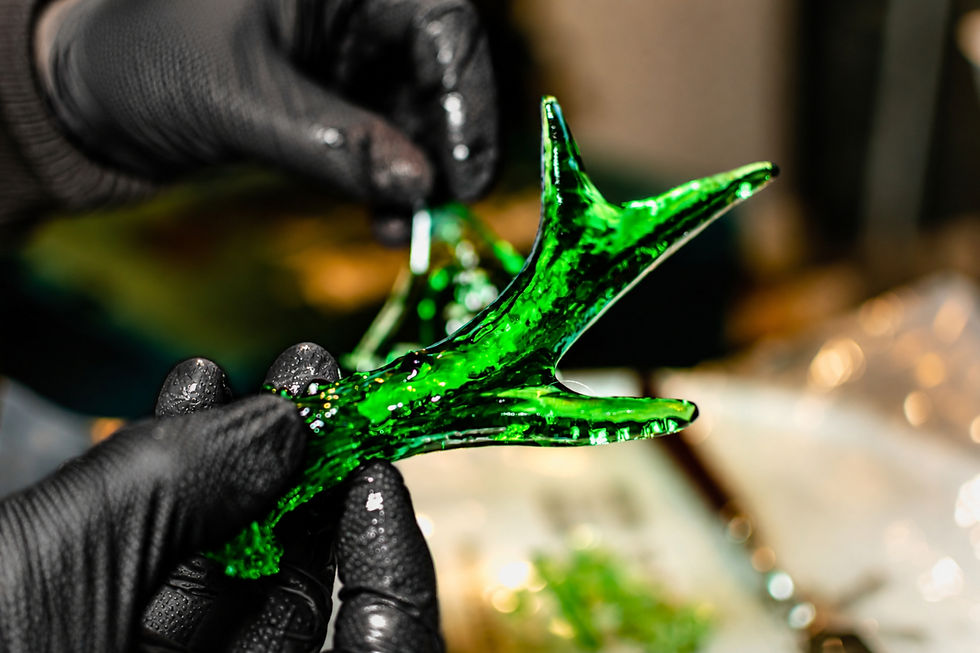
That's why literature on acrylates in dentistry, where the problem has been known for decades, emphasises avoiding any contact with uncured monomer at all, including preventing permeation through the glove. Sensitisation to one methacrylate can lead to sensitisation to other resins in that family, which has a real effect on continuing to work in the profession.
Cured resin is safe to touch. The whole problem concerns the liquid in the vat, a freshly removed print, supports, tools, and anything that's had contact with them.
Nitrile, latex or vinyl
Here the answer is unambiguous and backed by both institutional guidelines and permeation studies. 3D printing safety guidelines developed by Stanford University's Environmental Health and Safety office directly name disposable nitrile gloves for work with uncured resin, supports, and washing solutions.
Studies of methacrylate permeation through glove materials show the same thing. Compared with latex, nitrile gloves give longer protection against methacrylate contamination of the skin, as long as the mixture doesn't contain an organic solvent. In an in vivo study involving people sensitised to HEMA, a laminated glove gave the best protection, with a nitrile glove coming right after it.
Thickness decides how long, not whether the glove works
A review of studies on chemical permeation through gloves cited results for low-viscosity acrylates: nitrile gloves 0.01 cm thick, meaning 0.1 mm, resisted permeation for 30 minutes; at 0.045 cm, for 4 hours; and at 0.056 cm, for at least 8 hours. The difference between a thin examination glove and a heavier-weight glove isn't a few percent, it's an order of magnitude.
A second conclusion from these studies matters just as much. A breakthrough time worked out from the permeation rate can't be treated as a safe usage limit. It's a laboratory value, measured under fixed conditions, on a flat, taut piece of material, with no hand sweat and none of the stress that occurs when gripping the build platform.
Isopropyl alcohol changes the equation
You wash the print in IPA, and at that moment you stop working with resin alone and start working with resin dissolved in an organic solvent. That's not a minor detail.

In a study of HEMA and TEGDMA permeation through gloves, the average breakthrough time for five nitrile gloves was 15.7 minutes for concentrated substances, 9.9 minutes after dilution with ethanol, and 2.8 minutes after dilution with acetone. The solvent cut protection time several times over, and in its presence nitrile gloves also showed high permeation rates.
Isopropyl alcohol itself sits within nitrile's resistance profile, because alcohols are a group this material handles well. The risk, then, isn't that IPA will destroy the glove, but that resin dissolved in it reaches the skin faster than pure resin does. The practical takeaway: washing a print is the moment when the glove should be fresh and thick, not the same one you used to handle the vat half an hour earlier.
Which gloves for UV resin: the concrete answer
For resin printing, nitrile gloves that work well are Gripzzly X Long at a heavier weight, in the version with an extended cuff. They meet three conditions that follow from the studies above and from the nature of this work.

The first is material and weight. Gripzzly are nitrile gloves noticeably thicker than standard examination gloves, and with acrylates, thickness translates directly into protection time. The Gripzzly X Long glove also carries a type B mark under EN ISO 374-1 with codes K, P and T, meaning tested resistance to sodium hydroxide, hydrogen peroxide and formaldehyde, which means the product has been through permeation testing, not just a leak test.
The second is grip. The build platform is slippery with resin once removed, so is the IPA container, and dropping a print means uncured resin spilled all over the workstation. Gripzzly have a diamond texture across the whole gripping surface, which keeps grip on wet and oily surfaces.
The third is the cuff. When removing the platform, pouring resin through a strainer, and washing prints, liquid runs down onto the wrist. The Gripzzly X LONG has a 300 mm cuff, meaning it reaches high up the forearm, closing off the most common route of contact in this kind of work.
On top of that there's a point a workshop rarely thinks about, but a dermatologist often does: Gripzzly are made without latex and without thiurams, meaning without the two most common sources of contact allergy tied to the glove itself. When working with sensitising substances, there's no point adding a second allergen of your own accord.
One caveat, because honesty matters more than a convenient recommendation. No disposable glove, Gripzzly included, is a barrier for a whole session. During long work with resin, for example manually removing supports from a dozen or so prints, the glove is changed partway through.
The resin's safety data sheet says more than the description on the bottle
Resin manufacturers describe them in marketing language, using phrases like "skin-safe" or "low toxicity." The document that actually carries binding weight, though, is the safety data sheet.

Two sections are worth checking. Section 2 contains the classification under the CLP regulation, and for acrylate resins it most often includes phrases about skin and eye irritation and the potential to cause an allergic skin reaction. That last phrase matters more for glove selection than all the others, because a sensitising substance has no safe-contact threshold in the way a merely irritating substance does.
Section 8 gives the recommended personal protective equipment, including glove material and thickness and a breakthrough time, if the manufacturer has determined one. If section 8 has nothing beyond a generic mention of protective gloves, that's information in itself: the manufacturer hasn't tested its product from that angle, and the choice falls to the user.
Who's most exposed
A hobbyist printing a few models a month and a dental technician printing splints and models eight hours a day are working with the same material, but at a completely different scale of exposure. Acrylate sensitisation is a disease of cumulative dose, not a single incident.
The most exposed groups are dental and prosthetics labs, jewellery workshops casting on resin models, model-making and prototyping studios, and workshops printing in bulk on commission. In these settings, the glove stops being an accessory and becomes part of the workstation's equipment, with a set replacement frequency and stock held in storage, not one box bought once a quarter.
It's also worth remembering that the risk doesn't end with the person operating the printer. Uncured resin transfers onto door handles, keyboards and phones, so contact can reach someone who never even goes near the printer.
Rules worth pinning up above the printer
Gloves go on before a session starts, not after the first soiling. The contact that causes sensitisation is usually the one that goes unnoticed.
A glove is changed immediately after visible soiling with resin, and before moving on to washing in IPA. Washing the glove in alcohol and carrying on spreads resin across the material rather than removing it.
Don't touch a phone, a door handle or your face while wearing gloves that have had contact with resin. Acrylate sensitisation often shows up on the eyelids and neck, where skin is thinnest, rather than on the hands.
Used gloves and paper towels with resin on them are cured under UV light or in sunlight before disposal. Uncured resin is a hazard outside the workshop too, including for aquatic life.
For skin contact, wash with soap and water, not alcohol. Rinsing resin off with isopropanol increases its penetration through the skin instead of removing it.
Frequently asked questions
Are nitrile gloves enough for UV resin?
Yes, provided two conditions are kept: adequate thickness and changing after soiling. A thin examination glove used through a whole session doesn't do its job, even though it looks undamaged.
Can gloves be washed in IPA and reused?
No. The solvent speeds up resin permeation through the material, and a disposable glove doesn't go back into use after contact with a chemical. Alcohol removes resin from the surface, but not from inside the polymer.
How can you tell resin has passed through a glove?
You can't. Permeation happens at the molecular level and the glove doesn't change appearance. The first sign is usually itching, redness or a rash, a symptom that only appears after exposure.
Isn't latex more comfortable?
It is, and that's its only advantage for this use. Against methacrylates, latex protects for less time than nitrile, and it can itself be an allergen. With sensitising substances, that's a poor trade-off.
Are gloves needed for FDM printing too?
Not for the filament itself, since the material is solid and non-sensitising. Gloves are useful for cleanup work, gluing, and chemical post-processing of prints, meaning wherever a solvent comes into play.
How often should gloves be changed during resin printing?
With active contact with uncured resin, they should be changed after every visible soiling and before switching tasks, for example before moving on to washing a print in alcohol. During long support-removal work, the glove is changed partway through, not at the end, because breakthrough time runs from the first contact, not from the moment you notice soiling.
Does a glove protect against resin fumes?
No. A glove only guards the route of exposure through the skin of the hand. Fumes are a separate route of exposure, limited through ventilation, a closed printer lid during operation, and, with longer exposure, respiratory protection with an organic vapour cartridge.
Sources
Stanford University, Environmental Health and Safety, 3D Printing Safety and Health Guidance, 2023: ehs.stanford.edu
Phalen R.N. et al., Glove permeation of chemicals: the state of the art of current practice, Part 2, Journal of Occupational and Environmental Hygiene, accessed via PubMed Central (data on the effect of nitrile thickness on acrylate permeation): pmc.ncbi.nlm.nih.gov
Lönnroth E.C., Shahnavaz H., Permeability of different types of medical protective gloves to acrylic monomers, European Journal of Oral Sciences, 2003: onlinelibrary.wiley.com
Andersson T., Bruze M., Björkner B., In vivo testing of the protection of gloves against acrylates in dentin-bonding systems on patients with known contact allergy to acrylates, Contact Dermatitis, 1999: onlinelibrary.wiley.com
Sananez A. et al., Allergic reaction from dental bonding material through nitrile gloves. Clinical case study and glove permeability testing, Journal of Esthetic and Restorative Dentistry, 2020: onlinelibrary.wiley.com
Study of HEMA and TEGDMA permeation through latex and nitrile gloves in the presence of solvents, dermatological literature, data on breakthrough times of 15.7, 9.9 and 2.8 minutes
Regulation (EC) No 1272/2008 of the European Parliament and of the Council (CLP) on classification, labelling and packaging of substances and mixtures
Standards cited in the text: EN ISO 374-1, EN 16523-1, EN ISO 374-2, ISO 21420


Comments