

Does the colour of nitrile gloves matter?

Short answer: yes, but not in the way most people think. Colour doesn't change a glove's strength or its chemical resistance. What it does change is what you see on your hand while you work, and that has a very concrete effect on safety and hygiene. That's why black is the standard in some industries, and blue in others.
Where glove colours actually came from
The first nitrile gloves were dyed blue for a simple reason: so they could be told apart from white latex gloves at a glance. With a rising number of latex allergies, that wasn't cosmetics, it was a safety issue. Today the palette is much wider, but the mechanism is the same. Glove colour carries information, it isn't a technical parameter.
Does colour affect the strength of a nitrile glove
No. Pigment is added to the nitrile compound during production and has no effect on tensile strength, puncture resistance, or the integrity of the chemical barrier. A black and a blue glove made from the same compound at the same thickness will protect your hand exactly the same way.
It's worth saying this plainly, because there's a persistent belief online that black nitrile is "stronger". It comes from market history. Some manufacturers launched thicker, industrial-grade formulas specifically in black, to clearly separate them from thinner examination gloves. What was strong was the formula and the thickness, not the colour. If you want to know how much protection a glove will really give, look at the thickness, the standards and the PPE category, not the shade.
There is one exception worth knowing about: the quality of the pigment itself does matter. A contaminated dye with uneven particles can create weak points in the rubber's structure and increase the risk of skin irritation. That's an argument for choosing a manufacturer who knows what they're doing, though, not for choosing a particular colour.
What colour actually changes in practice

Visibility of dirt and damage
A light-coloured glove shows everything: a drop of oil, a smear of grease, a scuff, a small puncture. A dark one hides the same things effectively. Depending on the job, either one can be an advantage.
In a lab, in quality control, or when working with liquids, you want to spot any contamination within seconds. In a workshop, after an hour at the engine everything will be black anyway, so it's better if the glove still looks presentable at the end of the shift and nobody changes it every ten minutes just because of how it looks.
How it looks to the customer
Black gloves have taken over tattooing, cosmetics, barbering and detailing for a reason. They don't look clinical, they photograph well, and they don't show pigment or dye. That's a real argument anywhere you work in front of a customer.
Colour-coding workstations
In facilities that need to keep zones or process stages separate, assigning a different glove colour to each zone is the simplest possible safeguard against cross-contamination. Nothing needs explaining or checking, you just look at people's hands.
Double gloving
For tasks where scuffing happens often, wearing two pairs in different colours works well, with the lighter one underneath. A tear in the outer layer is visible immediately, because a different colour shows through the hole.
Food service and the food industry: here colour is already a procedure
Blue in the food industry isn't a matter of taste. It doesn't occur naturally in food, so a torn-off piece of glove is spotted on the product immediately. The BRCGS Food Safety standard's personnel requirement (clause 7.4.5) states outright that gloves must be single-use, food-contact approved, undamaged, and in a clearly distinguishing colour, preferably blue.

And here it's worth clearing up a misunderstanding repeated by many shops and blogs: it isn't Regulation (EC) 1935/2004 that requires gloves to be blue. Regulation 1935/2004 is about making sure materials intended for food contact don't transfer substances to it in amounts that endanger health. It doesn't say a word about colour. The requirement for a clear, contrasting colour comes from food safety standards and audit requirements such as BRCGS or IFS, and from in-house HACCP procedures implemented under Regulation (EC) 852/2004. The outcome is the same, but if you're preparing documentation or getting ready for an audit, it's better to know where the requirement is actually written down.
Which nitrile glove colour for which job

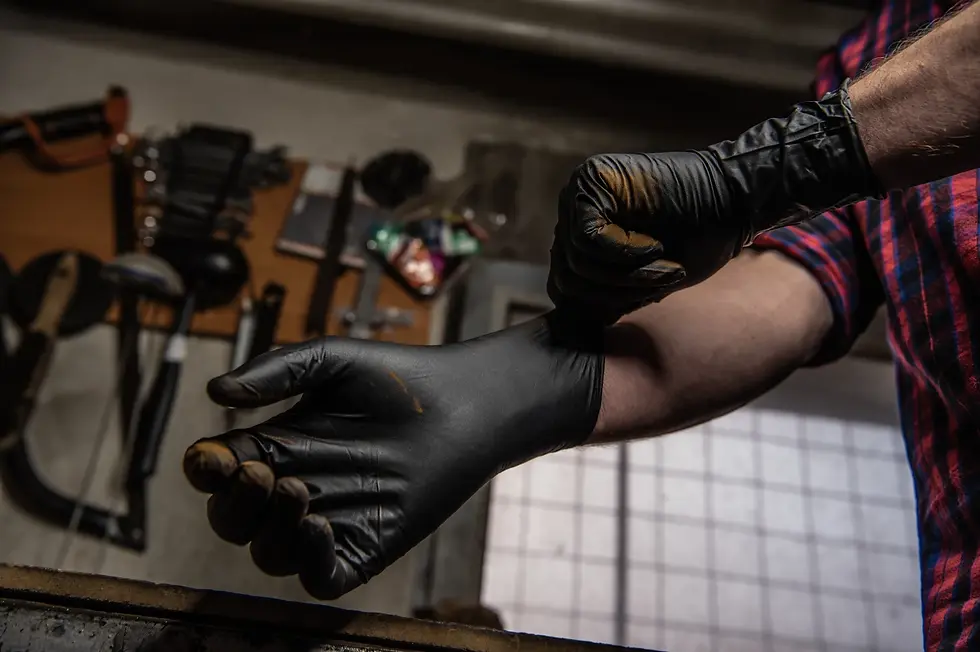
Black. Car workshops, mechanics, machine servicing, detailing, work with paints and adhesives, tattooing, cosmetics, barbering. Anywhere dirt is unavoidable and shouldn't show.
Blue. Food service, catering, food processing, laboratories, quality control, HACCP-covered areas. Anywhere dirt and damage need to be spotted immediately.
Orange. Work where the visibility of the hand itself matters: poorly lit stations, reaching deep into machinery, assembly, field service. It's also useful where several people share a workstation and you want to see at a glance whose hand is whose.
What to look at instead of colour
Pick the colour last. First check the parameters that actually determine protection:
glove thickness, because it affects resistance to chemical permeation and comfort during longer work
PPE category and type, for example category III type B for contact with chemicals
standards: EN ISO 374-1 for chemical resistance, EN ISO 374-5 for microorganisms, EN 388 for mechanical hazards, EN ISO 21420 for general requirements
AQL level, meaning the accepted pinhole level for the batch
no powder, latex or thiurams, if reducing the risk of irritation matters to you
surface texture, because it determines grip security on wet and oily parts
cuff length, especially when working with liquids
food-contact approval, if the gloves are going into a kitchen or onto a production line
It's also worth remembering that thicker nitrile gives better resistance to chemical permeation, but isn't automatically more resistant to puncture by a sharp tool. Those are two different things and two different standards.
Gripzzly: three colours, the same strength
Gripzzly nitrile gloves are available in three colours: orange, black and blue, plus a Gripzzly X version with an extended cuff for working with liquids. Every version is the same thick nitrile with a non-slip diamond texture, powder-free, free of latex and thiurams, a category III type B piece of PPE, compliant with EN ISO 374-5 and ASTM F 1671, and safe for food contact.
Colour doesn't change the level of protection here. What it changes is which workstation the glove suits best. Choose the one that makes your work easier, not the one that looks tougher.

Frequently asked questions
Are black nitrile gloves stronger than blue ones? No, not if we're talking about the same glove in two colours. Pigment doesn't change strength. Differences come from thickness and formula, not colour.
Why are blue gloves used in food service? Because blue doesn't occur naturally in food, so a torn-off piece of glove is spotted in the product immediately. This is a requirement of food safety standards and audits, not of the food-contact materials regulation itself.
Does glove colour have legal significance? EU rules on personal protective equipment and food-contact materials don't mandate a colour. Industry standards, audit requirements and in-house facility procedures do, however.
Which glove colour should you choose for a workshop? Black, if you want to hide grease and oil. Orange, if hand visibility in poor lighting or tight spaces matters more.
Can black gloves be used for food? Technically yes, if the glove has food-contact approval. In facilities covered by food safety audits, though, blue will be the standard, so black is better suited to a home kitchen than to a production line.


Comments