

Diamond-textured gloves, or the physics of a confident grip

Everyone knows this moment. The socket sits on the bolt, your hand is in a good position, you pull and suddenly the wrench skids sideways, and your knuckles land on the manifold. The reflex diagnosis always sounds the same: I wasn't holding on tight enough.
That, though, is almost never true. Your hand held on exactly as hard as it decided was necessary, and it made that decision without asking you, within tens of milliseconds of touching the wrench. The whole problem is what that decision was based on.
The hand doesn't squeeze as hard as it can, only as hard as it has to
In the 1980s, Swedish neurophysiologists Roland Johansson and Göran Westling described something that's now the foundation of what we know about grip. When you pick something up, your nervous system instantly estimates the friction between skin and object and sets the grip force just above the minimum needed to stop the object slipping out. That margin is surprisingly small, because squeezing with extra safety margin costs energy and reduces precision.

The second part of this system is even more interesting. When a micro-slip happens, one you don't even consciously register, receptors in the skin send a signal, and the grip force rises automatically after about 74 milliseconds. That's roughly half the time a consciously intended change in force needs. In other words, your hand corrects its grip faster than you can think about it.
This leads to a conclusion that turns the whole intuition on its head. You don't decide how hard you hold on. Friction decides. And if that's true, anything that lowers friction automatically raises the force your hand has to generate to hold the same wrench. Eight hours of that kind of work is felt in the forearm by evening.
Slipperiness doesn't come from the oil, it comes from pressure
Here we get to the heart of it, and the best data on this doesn't actually come from glove research at all, but from research into shoe soles, where the same problem has been worked out in exceptional detail.
When you press a smooth surface against another smooth surface with liquid between them, the liquid has no way to escape. It starts getting compressed and pressure builds up inside it. That pressure literally starts lifting one surface off the other, until material-to-material contact disappears and only material-to-liquid-film contact remains. In the literature this is called the squeeze film effect and the wedge effect. The effect is simple: friction drops.

And now the least obvious consequence. A surface that maximises contact area by eliminating every groove doesn't actually hold better. In the presence of liquid it behaves the opposite way, because it slides most easily into a state of full hydrodynamic lubrication, in which a large contact area no longer matters at all, because there simply is no contact.
That's why a completely smooth glove on an oily bolt behaves like an ice skate. Not because it's made of an inferior material. Because it gave the oil no way to escape.
What diamond texture actually does
Grooves are an escape route for liquid. Sole research shows this clearly: channels in a tread drain fluid out from under the contact surface, lower hydrodynamic pressure, and genuinely reduce slip risk compared to surfaces without such channels. When the tread wears down and the channels disappear, drainage capacity drops, and friction drops along with it.

Diamond texture is simply a grid of such channels, laid out in diamonds. What matters here is the geometry, not the name. Parallel grooves work great, but only when force acts across them. The problem is that in a workshop the direction of force is completely unpredictable, because one moment you're pulling, the next pushing, the next twisting your wrist sideways, and the next holding something that's trying to rotate on its own. A diamond grid gives drainage paths in several directions at once, so it doesn't matter how you happen to angle your hand.
It's worth being honest here, because a lot gets promised in this industry. The classic 1996 Cadoret and Smith study showed that grip force scales with the inverse of the friction coefficient regardless of surface texture. In other words, texture on its own isn't magic. It's a way of raising friction in conditions where a smooth surface would lose it. On clean, dry metal, the difference will be small. Its whole value shows up exactly where liquid appears, which in a workshop is more or less always.
The scale of the effect can be larger than it seems. In a study carried out in the service industry, footwear with a properly designed sole geometry cut the number of slips and falls by as much as 54 percent. That's data about shoes, not gloves, and it shouldn't be applied directly. What it does show is how much liquid-drainage geometry alone can achieve.
Working with grease: where it shows the most
Grease is harder than oil, because it's thicker, and the higher the viscosity, the longer it takes to drain the fluid out from under the contact surface. A glove has a fraction of a second for that, exactly as long as it takes to close the hand.
In practice this means that with a slippery grip your nervous system raises its safety margin and makes you squeeze harder. There are three effects, and all of them are bad. Your hand tires faster. Precision drops, because with a high grip force it's harder to make a subtle movement. And the sneakiest one: you lose the sense of torque, the feedback from your fingers that tells you a bolt has just started turning too easily, meaning you're probably stripping the thread.

A confident hand when working with grease isn't about nothing slipping out. It's about not having to squeeze with a safety margin, which leaves you a margin for precision.
There's a limit here that has to be said plainly. No texture replaces a rag. If a smooth shaft is coated in a thick layer of grease, the channels fill up with it and stop draining anything, because there's nowhere for it to go. That's actually the answer to why a grease-caked glove holds just as badly as a smooth one. At that point it genuinely is smooth, because the texture has been flooded. Swapping for a clean glove works faster at that point than any grip adjustment.
Using your phone without taking the glove off, or what all this physics is actually for
A phone screen is a capacitive screen. Under the glass sits a grid of electrodes that maintains an electrostatic field and constantly measures its capacitance. A finger is conductive, so bringing it near the glass disturbs that field in a way the controller can recognise and locate.
A glove enters this as an extra dielectric layer. The thicker it is and the better it insulates, the further it pushes the conductive finger away from the grid, and the weaker the signal reaching the controller, until at some point it stops being distinguishable from noise. That's why a thick knitted or leather glove doesn't work, while a thinner nitrile glove does, because it barely changes that distance.
It sounds like a piece of trivia, but it's one of the more important practical arguments in this whole topic. The biggest enemy of gloves isn't the absence of gloves, it's the cost of using them. If you have to pull them off and put on new ones every time you check a part number, take a photo for the paperwork, or take a call from a customer, then by the third time nobody bothers putting them back on. A glove you can wear without interrupting your work simply gets worn.
Two practical caveats. Excess moisture on the glove or on the screen disrupts a capacitive screen regardless of what's on your hands. And second: greasy fingers leave a film on the glass that can itself worsen responsiveness, so it's worth wiping the phone down every so often anyway.
What this means for your choice
Texture makes sense across the whole gripping surface, meaning the palm and all the fingers, not just the fingertips. A light knurl on just the fingertips is a solution designed for entirely different tasks than holding an oily wrench.
Size determines whether the texture works at all. A glove that's too big bunches into folds, and a fold means loose material sits at the contact point instead of a pressed-down grid of grooves.
And the simplest point: a grease-caked glove gets replaced, rather than searched for a better grip.

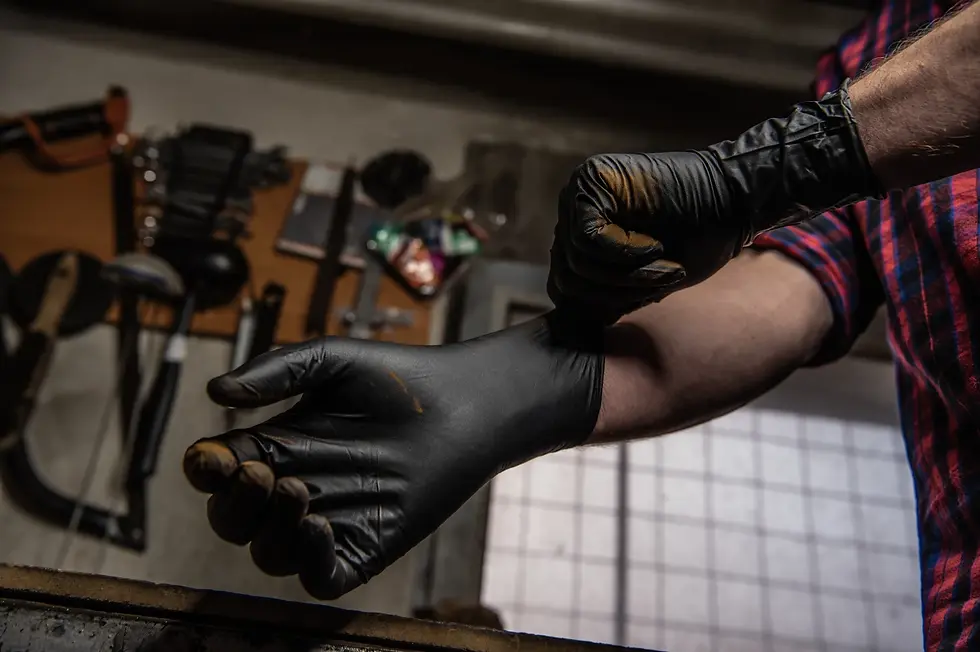
Gripzzly have a diamond texture spread across the whole gripping surface of the palm and fingers, in nitrile with no latex, thiurams or powder, category III personal protective equipment, type B under EN ISO 374-1, AQL 1.5, in sizes S to XXL. You can use your phone in them without taking them off, which turns out to be a surprisingly practical argument when working from a parts catalogue.
In closing
The best grip is the one you don't think about at all. Your hand will work everything out itself anyway, in 74 milliseconds, without consulting you. The only thing you can do for it is give it a surface where that calculation comes out in your favour.
Sources:
Grip force regulation as a function of friction, and the safety margin: Westling, Johansson, Factors influencing the force control during precision grip, Exp Brain Res 1984, PubMed 6705863 and Johansson, Westling, Roles of glabrous skin receptors and sensorimotor memory, Exp Brain Res 1984, PubMed 6499981
Automatic grip correction after a micro-slip in 74 ± 9 ms: Johansson, Westling, Signals in tactile afferents from the fingers eliciting adaptive motor responses during precision grip, Exp Brain Res 1987
Grip force scales with the inverse of the friction coefficient regardless of texture: Cadoret, Smith, Friction, not texture, dictates grip forces used during object manipulation, J Neurophysiol 1996, PubMed 8734595
The squeeze film effect, the wedge effect, and rising pressure in liquid with no escape route: Worn region size of shoe outsole impacts human slips, Journal of Biomechanics 2020
Fluid-draining channels and reduced slip risk, including the 54 percent fewer slips figure in the service industry: Changes in under-shoe traction and fluid drainage for progressively worn shoe tread, Applied Ergonomics 2019
A large contact area with no channels favours hydrodynamic lubrication and lowers friction: Prediction of coefficient of friction based on footwear outsole features, CDC
Fluid-draining grooves and the effect of their geometry on the friction coefficient: The effect of shoe soling tread groove width on the coefficient of friction, Applied Ergonomics 2004
How a capacitive screen works and the effect of glove thickness on the signal: PIP, Gloves and Touchscreen Compatibility, white paper PDF


Comments