

Best workshop gloves for a car mechanic

Someone types that phrase into a search engine expecting a ranked list of workshop gloves from first to tenth place. The problem with such lists is that they measure something that doesn't really matter much. A glove that's ideal for an oil change can be a bad idea for a can of brake cleaner, and the difference doesn't lie in the logo on the box, it lies in the chemistry.
It's worth remembering why we're even talking about this. According to 2023 Eurostat data, upper limbs, meaning shoulders, arms and hands, accounted for 39.8 percent of all non-fatal workplace accidents in the European Union. In manufacturing, that share reached 52.3 percent. Hands are simply what we work with, so they're also what takes the hit most often.
Instead of a ranking, I'll propose six criteria you can check for yourself in a few minutes, on any box and on your own hand.
How many different tasks fit into one day?
Before we get to the criteria, one observation. A mechanic's typical day in a car workshop isn't one task involving chemicals, it's several completely different ones.

An oil change means contact with mineral oil. Brake work means cleaner, meaning solvents. The cooling system means glycol. The battery means sulfuric acid. Air conditioning means compressor oils. Cleaning parts means a degreasing bath. The car's interior, meanwhile, is a completely different problem, because there what matters most is not leaving marks.
One glove can't be the best in all these situations at once, because they call for different things. What it can be is very good in most of them, with clearly defined limits that you know about. That's a realistic definition of “best” for a mechanic and a workshop.
Criterion one: incidental contact or immersion
This is the most important distinction in this whole topic, and at the same time the least often stated out loud.
American universities, whose labs go through nitrile gloves by the hundreds of pairs a day, write about this in their safety guidelines. A disposable glove is intended solely for incidental contact, and a glove chosen for incidental contact is often unsuitable for prolonged contact, meaning contact where the hand is coated in or immersed in a substance. Cornell University adds a rule that should hang over every workstation: when a substance gets onto the glove, the glove is taken off and replaced as fast as possible.
Translated into workshop terms, it sounds like this. A disposable glove is a barrier against splashes and brief contact. It isn't a suit for holding your hands in a tray of degreaser. And more importantly, it's replaced when it gets dirty, not when it wears through. That's an entirely different moment.
Criterion two: the chemistry you can't see
This is the place for one specific fact worth knowing before you buy anything.
Nitrile handles oils, greases, petroleum products, fuels, and many acids and alkalis very well. It does have one clear weakness, though, and that weakness happens to live permanently in a workshop. It's ketones, chiefly acetone.

Non-chlorinated brake cleaners very often rely precisely on acetone. In one patent description, a typical formula contains roughly 25 to 55 percent acetone by weight, alongside methyl acetate and hydrocarbons. Acetone permeates thin nitrile very quickly, and for the thinnest gloves, within a matter of single-digit minutes.
This isn't an argument against nitrile, it's a user manual. A splash of cleaner means changing the glove, not wiping it on your trousers. You don't hold a part in your hand while you're pouring cleaner over it. You don't wet a rag through a glove. For prolonged work in solvents you need a glove from a completely different category, thicker and reusable.
On the box, there are three things to look for: category III personal protective equipment, the EN ISO 374-1 pictogram together with letters denoting the specific test chemicals, and type A, B or C, which tells you for how many substances on the list an adequate breakthrough time has been confirmed.
Criterion three: thickness, or what you pay for in strength
There's a common belief that a thicker glove is simply better. The data says something else.
Studies on how gloves affect grip strength show consistent drops. In a review published in the ergonomics literature, strength reductions ranged from 7.3 percent for cotton gloves to 16.8 percent for double-gloving. Earlier work pointed to drops of around 15 to 20 percent for wearing gloves at all. NIOSH researchers, measuring grip strength on cylindrical handles, stated outright that glove thickness is one of the main factors behind this effect, and warned that a user of a thicker, stiffer glove may be trading one health risk for another.
To be fair: these studies concerned industrial gloves, much thicker than disposable ones, so the numbers shouldn't be applied directly to nitrile a fraction of a millimetre thick. The direction of the relationship, though, is unambiguous and worth remembering.
This, incidentally, settles the question of wearing two pairs at once. In the review cited above, it was double-gloving that gave the biggest drop in strength. An older study on a slippery handle, in turn, found that for pulling, pushing and wrist-bending torque, a single glove improved results. Double-layering makes sense in very specific situations, for example when you want to instantly strip off the top pair after a dirty task, but it isn't better by default.
Criterion four: the size almost nobody measures
The EN ISO 21420 standard bases its sizing system on hand circumference and hand length, defining sizes in a range from 4 to 13. There's a catch worth knowing about, though: the standard requires the manufacturer to define its own sizing system corresponding to the hands the gloves fit. In other words, the labels S, M and L aren't universal between brands, and the only reliable reference point is that specific manufacturer's size chart.
It's worth measuring yourself. Circumference is measured with a tape around the palm, excluding the thumb, and length from the wrist crease to the tip of the middle finger. Two numbers, two minutes, and then you just check them against the chart.
The same standard also describes an objective way of assessing dexterity, a test based on picking up pins of decreasing diameter, from 11 millimetres down to 5, scored across five levels. If you've ever wondered whether “good feel” can actually be measured, this is how.
Criterion five: the cuff, or where liquid gets in
A standard disposable glove is around 240 millimetres long, meaning it covers the hand and a bit of the wrist. Longer versions, for example 250, 260 or 300 millimetres, reach noticeably further up the forearm.
For a mechanic's workshop gloves, this isn't a cosmetic detail. When draining oil, changing coolant or washing parts, the hand is very often raised, and liquid runs towards the elbow, looking for a way in exactly where the cuff ends. If there's a lot of that kind of work in a day, a longer cuff solves a problem that working technique alone can't otherwise fix.
Criterion six: the number nobody counts
Most workshops compare the price of a box of disposable workshop gloves. That's convenient, but it leads you astray, because a box isn't the unit work actually happens in.
If the rule says that a nitrile glove is replaced once it gets dirty, then changing pads and cleaning the guide pins can use up two or three pairs, and that's correct behaviour, not waste. If, on the other hand, a glove splits just from being put on, or tears on first contact with a sheet-metal edge, consumption rises for a completely different reason.

Working this out for yourself is trivially simple. You take one repeatable task, for example an oil and filter change, and count over a week how many pairs it uses up. The result multiplied by the price per pair tells you more than any ranking.
What a disposable glove won't do
Three things that need to be said plainly, because leaving them out would be dishonest.
It doesn't protect against cuts. A sharp sheet-metal edge, a circlip or a spring will cut through it without resistance. For mechanical hazards, gloves tested to EN 388 are the right tool, an entirely different product category, and if the job is mostly bodywork, that's where to look.
It doesn't protect against prolonged chemical contact, as covered above.
And it isn't worn near rotating machinery. At a lathe, a pillar drill or a grinder, the glove comes off, because the material catches on the rotating part faster than you can pull your hand back.
The five-minute test
All of the above can be boiled down to a simple procedure that can be run on any product.
Measure your hand's circumference and length, then check them against the manufacturer's chart instead of picking a size out of habit. Put the glove on and clench your fist, looking at your palm: folds at the gripping surface mean the size is too big. Work through one full task in it, a real one involving actual oil, not a dry test run. After taking it off, look at and smell the inside of the glove, because moisture that isn't sweat, or a solvent smell, means the barrier stopped working sooner than you thought. Finally, read the box and check the category, type, letters and AQL.
Five steps, one afternoon, and you have an answer based on your own workstation instead of someone else's subjective list.
Where does Gripzzly fit into all this?
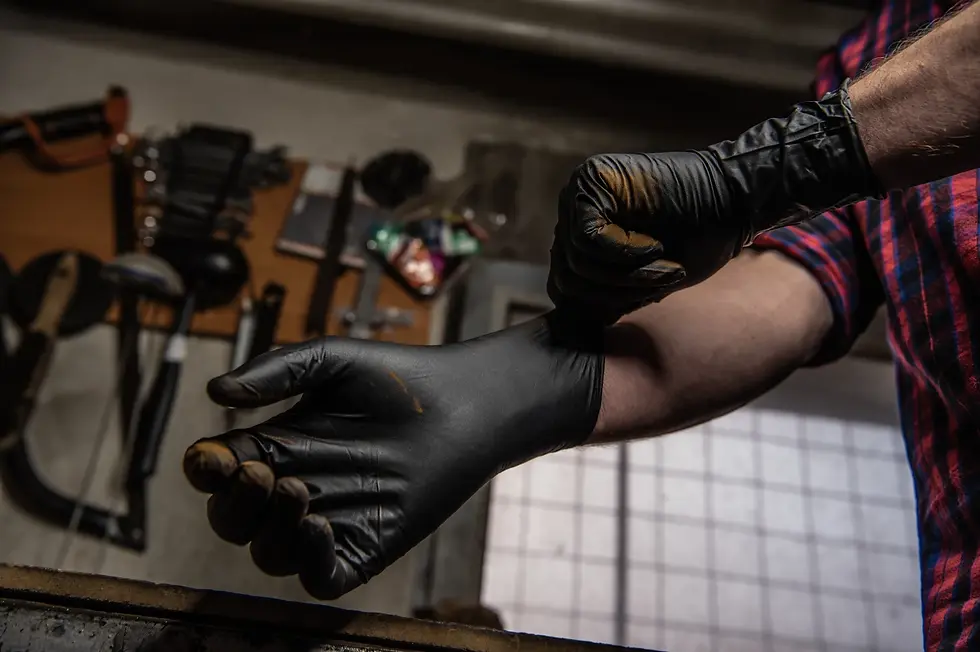
Gripzzly were designed for that first, most common scenario, everyday work with oil, grease and fuel. Nitrile with no latex, thiurams or powder, category III personal protective equipment, type B under EN ISO 374-1, AQL 1.5, compliant with EN ISO 374-5 and ASTM F1671, food-contact approved, diamond texture across the whole gripping surface of the palm and fingers, sizes from S to XXL. For work where liquid runs towards the forearm, there's the X Long version with an extended cuff.

For prolonged work in acetone and other ketones you need a glove from a different shelf entirely, and that sentence stays here deliberately, because it's better to know it now than halfway through the job.
Workshop gloves for a mechanic: the summary
The best workshop glove isn't the one that wins a comparison chart. It's the one you actually have on your hand the moment a can of cleaner twists in your grip and sprays somewhere it wasn't supposed to.
The rest is technical detail, though those particular details, as usual, decide everything.
Sources
Share of upper-limb injuries in workplace accidents, 39.8 percent in the EU and 52.3 percent in manufacturing in 2023: Eurostat, Accidents at work, statistics by economic activity
Disposable gloves for incidental contact only: University of Tennessee EHS, Glove Selection 2024 (PDF) and MIT EHS, Glove Selection Table (PDF)
The rule of replacing a contaminated glove immediately, and the difference between incidental and prolonged contact: Cornell EHS, Types of Gloves
Rapid permeation of certain substances through nitrile: Michigan State University EHS, Specialized gloves
Typical composition of non-chlorinated brake cleaner, 25 to 55 percent acetone: US Patent 6448209, Brake cleaner compositions comprising methyl acetate and acetone
Nitrile's limited resistance to ketones and fast breakthrough of thin gloves by acetone: gloves.com, Guide to Nitrile Gloves Chemical Resistance (industry source, not peer-reviewed)
Grip-strength reductions from wearing gloves, from 7.3 percent to 16.8 percent for double gloves, and the Riley et al. results for a slippery handle: Effects of gloves on maximum force and the rate of force development, International Journal of Industrial Ergonomics
Glove thickness as the main factor in grip-strength loss: NIOSH, Effects of Gloves on the Total Grip Strength Applied to Cylindrical Handles
A sizing system based on hand circumference and length, sizes 4 to 13, the manufacturer's own system, and the dexterity test: ISO 21420:2020 (standard excerpt, PDF)
Standard disposable glove length of about 240 mm and longer versions: Shield Scientific, Understanding EU standards for disposable gloves


Comments