

Auto detailing gloves: how to choose and what to avoid
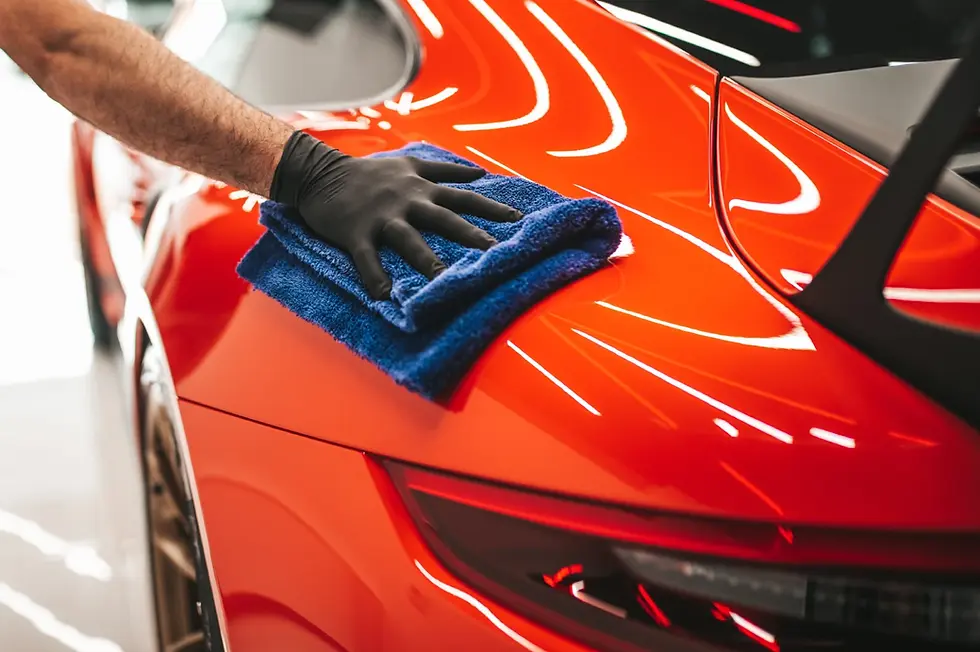
Detailing is work in which your hands are in contact with chemicals for most of the shift. Alkaline shampoos, wheel cleaners, tar removers, isopropyl alcohol for degreasing, polishing compounds, ceramic coatings. Auto detailing gloves therefore have to reconcile two things that usually rule each other out: a secure grip with a wet hand and resistance to whatever is in the bottle. Below, specifically what to look for, where nitrile is enough and where no disposable glove is enough.
The short answer
For auto detailing the best choice is nitrile gloves of a higher weight, with a textured gripping surface and an extended cuff. Nitrile resists oils, greases, petrol and other aliphatic hydrocarbons, alcohols, and medium-strength acids and alkalis, which covers most of the chemistry used in detailing. It does not protect against ketones, and it is not enough for acidic wheel cleaners containing hydrofluoric acid. A thin examination glove is not suitable for cleaning wheels, because it loses its properties faster than the task itself takes.
What a detailer actually works with
Choosing gloves starts with a list of substances, not with the price of the box. Detailing chemicals fall into several groups that behave towards nitrile in completely different ways.
Nitrile appears in polymer material charts as resistant to medium-strength acids and alkalis, to aliphatic hydrocarbons, meaning petrol, oils and greases, and to alcohols and amines. That covers the vast majority of a typical day in a detailing studio. Ketones are not on that list, and that is a limit which neither price nor brand moves.
Acidic wheel cleaners, the most serious hazard in detailing
Vehicle cleaning products, rust removers and aluminium brighteners often contain hydrofluoric acid, because it breaks down road grime effectively. The scale of the problem is documented. In Washington State between 2001 and 2013 one death and 48 chemical burns linked to washing cars and trucks were recorded, and the people affected were mostly detailing and car wash workers. Seven workers required hospitalisation and two required surgery. Importantly, concentrations in working solutions were below one percent and in concentrates up to twenty percent, and both levels are dangerous.

Hydrofluoric acid acts in two ways. Hydrogen ions cause local corrosive damage, while fluoride ions penetrate deep into tissue, causing liquefactive necrosis and binding calcium and magnesium, which leads to electrolyte disturbances, primarily hypocalcaemia. The burn is often barely painful at first, so the worker does not react immediately.
The practical conclusion for a detailing studio is simple. Section 3 of the safety data sheet for a wheel cleaner tells you whether hydrofluoric acid or hydrogen fluorides are in the formula. If they are, a disposable nitrile glove is not the right protection. In EN ISO 374-1 hydrofluoric acid at 40 percent carries the letter code S, and disposable gloves practically never have tested resistance to this substance. Such work calls for a thick chemical-resistant glove selected against the safety data sheet, and better still a switch to a safer product, because alternatives based on citric, phosphoric or oxalic acid are available.
What to check on the glove box
Gloves protecting against substances and mixtures hazardous to health fall into category III of personal protective equipment under Regulation 2016/425 and are subject to assessment by a notified body. On the box you will find the flask pictogram with letters, and each letter corresponds to one test chemical.
Type A means resistance to six chemicals for more than thirty minutes, type B to three chemicals for more than thirty minutes, type C to one chemical for more than ten minutes. Gripzzly Black gloves carry a type B marking with the codes K, P and T, meaning tested resistance to sodium hydroxide, hydrogen peroxide and formaldehyde. There is no letter S or B in that set, and there should not be, because no manufacturer of disposable gloves declares such resistance.
Thickness and texture, or why cheap gloves fail on wheels
The most common complaint in the detailing community concerns gloves that fall apart in your hands while cleaning wheels. The cause usually lies not in the chemistry but in the weight and the mechanics.
A thin examination glove is designed for short, delicate tasks. In detailing the hand works in a wet environment, reaches into the gaps of a wheel, rubs against edges and works under load. A thicker wall extends the breakthrough time, but above all it gives the mechanical durability that thin nitrile simply does not have.

The second parameter is texture. A smooth glove on a wet hand loses grip exactly when you are holding a bottle of product or a polisher. Gripzzly gloves have a diamond texture across the whole gripping surface, which works like a tyre tread and maintains traction on contact with water, foam and oil. This is not a cosmetic detail but a feature that genuinely reduces the number of tools dropped.
The third element is cuff length. When washing wheels, cleaning upholstery or the engine bay, liquid runs down the forearm and gets inside the glove, which in practice means skin contact despite the protection being worn. The Gripzzly X LONG version has a 300 mm cuff that covers the forearm and removes this problem.
Glove colour in detailing. Why black?
Black nitrile caught on in workshops and detailing studios for practical reasons. Grease, tar and polishing compounds do not show on it, so the glove looks tidy in front of the customer and the worker does not change it just because it looks unsightly. The orange version, available in the Gripzzly line, has the opposite advantage: dirt shows clearly on it, so it is easier to judge when to change gloves when working with chemicals.
This is a real operational choice, not a matter of taste. If you work mainly mechanically, black makes sense. If you work with chemicals and want to see when a glove is contaminated, a lighter colour works in your favour.
Nitrile, latex or vinyl for detailing
Next to nitrile on the shelf there are usually two cheaper alternatives, and both perform poorly in detailing, though for different reasons.
Latex, that is natural rubber, has alcohols, aldehydes and ketones on its resistance list, but it does not protect against organic and non-polar solvents or against petroleum-derived compounds. In detailing that rules it out straight away, because tar removers, oils and most degreasers belong to exactly that group. On top of that comes the issue of latex proteins and allergies, which is pushing the material out of many professional applications.
Vinyl, that is plasticised polyvinyl chloride, is listed as resistant to oils, fats and ozone, but it is mechanically the weakest of the three and fits the hand worst. In work that demands grip and precision it tears fastest, so the apparent saving disappears once you count the pairs used.
Nitrile wins in detailing not because it resists everything, but because its resistance profile matches what actually stands on the studio shelf: oils, greases, aliphatic hydrocarbons, alcohols and medium-strength acids and alkalis.
Size, fit and how to take gloves off
A glove that is too large gathers into folds on the palm and limits feel, while one that is too small stretches the material, which shortens the real protection time, because stretching reduces the wall thickness. EN ISO 21420 covers glove dimensions and dexterity precisely because fit is a safety parameter, not a comfort one.

A practical tip when ordering for a studio: you usually need three sizes, not one universal size. A worker who finds a glove uncomfortable will take it off at the first task that demands precision, and that is exactly when skin contact happens.
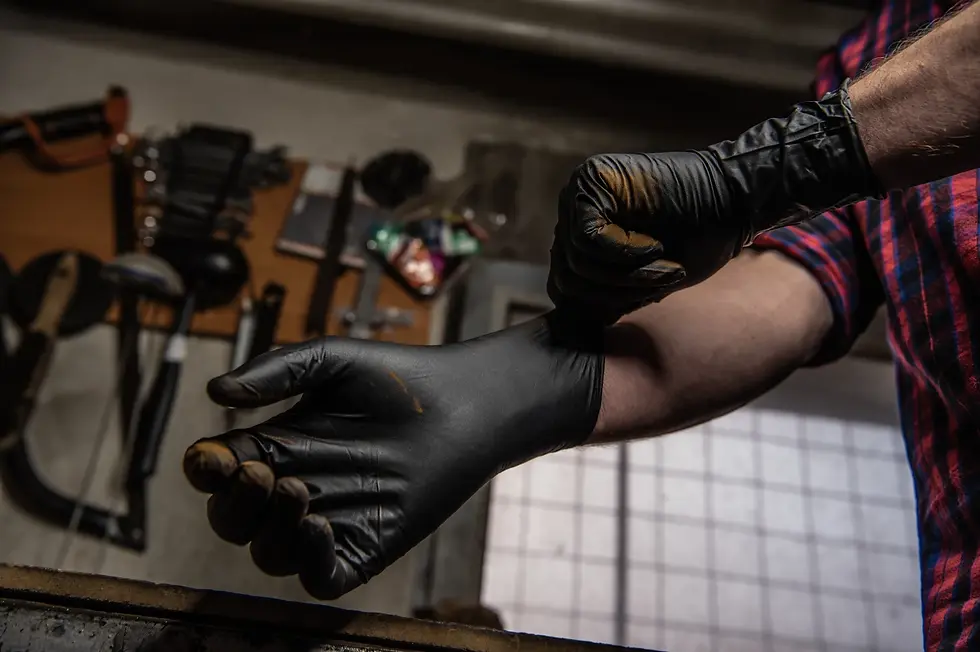
Taking gloves off is a separate matter. A contaminated glove carries chemicals on its outer surface, so pulling it off with the fingers of the other hand transfers the contamination exactly where it was meant not to go. The correct technique is to grip the first glove at the cuff, pull it off inside out, then slide a finger under the cuff of the second glove from the inside and pull it off over the first one. It sounds fussy, but it is the only moment in the whole process when the protection itself can become the source of exposure.
Skin hygiene in shift work
Detailing means working in a wet environment, and prolonged glove use is a separate burden on the skin of the hands. Three rules worth putting in place in a studio.
First, change gloves after contact with chemicals, not after finishing the task. The material loses its barrier properties before anything worrying is visible on it.
Second, gloves free of latex and free of thiurams, meaning without vulcanisation accelerators from that group, reduce the risk of allergic reactions in daily use. Gripzzly are made without latex and without thiurams. It is worth remembering that the absence of latex does not mean the absence of any allergy risk, only the removal of its most common cause.
Third, storage. Nitrile gloves have a defined shelf life, three years in the case of Gripzzly, and the durability of the material is affected by ozone, UV radiation and temperature. A box kept by a window or next to a heater ages faster than the date on the packaging suggests.
Frequently asked questions
Which gloves for cleaning wheels?
For pH-neutral products and fallout removers without hydrofluoric acid, a higher-weight nitrile glove with an extended cuff is enough. If section 3 of the safety data sheet lists hydrofluoric acid or a hydrogen fluoride, a disposable glove is not adequate protection.
Do nitrile gloves withstand contact with IPA?
Alcohols are on nitrile's resistance list, so degreasing a panel before applying a coating is a typical and safe use. With prolonged contact the same rule applies as always: the breakthrough time stated by the manufacturer decides, not the general category.
Can you use a phone in nitrile gloves?
Thin nitrile usually lets you operate a capacitive screen, a thicker workshop glove not always. That is a real trade-off between feel and durability, worth keeping in mind when choosing the weight.
How many pairs of gloves does a detailing studio use?
It depends on how the work is organised, but usage rises sharply once the discipline of changing gloves after chemical contact is applied properly. With that model, buying bulk packs pays off more than single boxes, and the cost per pair matters more than the price of the box.
Are black or orange gloves better for detailing?
Black hides grease and polishing compounds, so it stays presentable in front of the customer for longer. Orange shows contamination, which makes it easier to control when to change gloves when working with chemicals. The choice depends on whether the priority is customer-facing appearance or change discipline.
Can nitrile gloves be used a second time?
Disposable gloves are intended for single use and should not be put on again after contact with chemicals. Material that has let a substance through holds it within its structure, and washing a glove while it is on the hand spreads the contamination instead of removing it.
Sources
Reeb-Whitaker C.K., Eckert C.M., Anderson N.J., Bonauto D.K., Occupational Hydrofluoric Acid Injury from Car and Truck Washing. Washington State, 2001–2013, Morbidity and Mortality Weekly Report, CDC, 2015: cdc.gov
Halicka K., Irzmańska E., Rękawice ochronne w zagrożeniu chemicznym. Czy wiem, jak długo mogę je stosować?, Central Institute for Labour Protection – National Research Institute, 2024: ciop.pl
California Department of Toxic Substances Control, Product – Chemical Profile for Cleaning Products Containing Hydrofluoric Acid, 2024: dtsc.ca.gov
University of Pennsylvania, Environmental Health and Radiation Safety, Nitrile Glove Chemical-Compatibility Reference: ehrs.upenn.edu
Regulation (EU) 2016/425 of the European Parliament and of the Council of 9 March 2016 on personal protective equipment: eur-lex.europa.eu
Standards cited in the text: EN ISO 374-1 (chemical resistance, letter codes and types A, B, C), EN 16523-1 (breakthrough time), EN ISO 21420 (general requirements)


Comments