
Which gloves for the automotive industry? Production, windscreen installation, bodywork and paint shop
Updated: 4 days ago
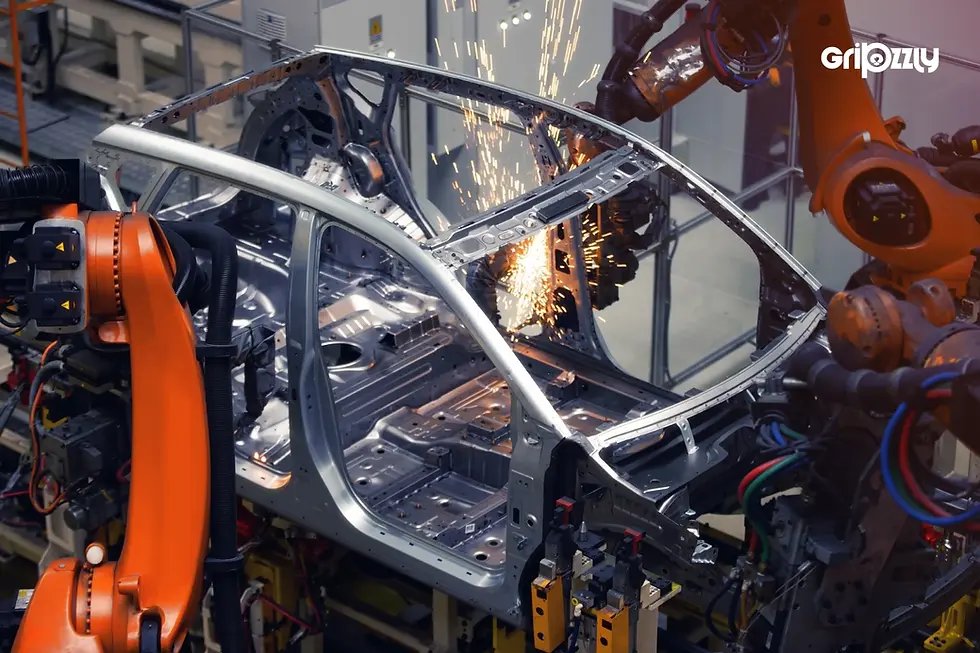
An automotive production plant is not a single workstation but a dozen different chemical environments under one roof. Machining soaks the hands in emulsion, bonding windscreens involves isocyanates, the paint shop uses hardeners, and assembly means oils, greases and sharp sheet-metal edges. A glove that works in one zone is sometimes useless in the next. Below, concretely: where the real skin hazards lie, what research institutions' data says about them, and why thick nitrile with texture on both sides is the default solution in this industry.
The short answer
For automotive production and assembly, use thick, powder-free nitrile gloves with a gripping texture, changed after contact with chemicals. Gripzzly are 0.20 mm thick on the fingers and on the palm, four times the minimum that ASTM D6319 sets for nitrile examination gloves, with a diamond texture across the whole gripping surface and a negative diamond texture on the inside, which holds the hand in the glove and limits slipping of sweaty skin. Nitrile is also the material named directly by the British health and safety authority for work with isocyanates, that is for bonding windscreens and painting, and its resistance at the same time covers oils, greases and machining emulsions.
Four risk zones in an automotive plant
Before we get to materials, it is worth separating the zones, because in each of them the glove is responsible for something different.
Bonding windscreens: a hazard you can't see in the air
Windscreen installation today relies on one-component, moisture-curing polyurethane adhesives, and their ingredient is isocyanates, most often MDI. Safety data sheets of such products carry a classification as a skin sensitiser in category 1 and a respiratory sensitiser in category 1, with a note that people previously sensitised to isocyanates may react across to other compounds in this group.

The strongest evidence that with isocyanates it is the skin and not the air that decides comes from a study by the British health and safety authority. In a plant making floor panels with an MDI-based adhesive, workers wore leather gloves, and biological monitoring showed urinary MDI levels well above the national reference value. After the gloves were replaced with polyester ones with a coated palm, the share of workers exceeding that value fell from three quarters to one quarter, and only slightly above the threshold at that. Airborne MDI concentrations stayed unchanged, which means skin contact was the main source of exposure.
The conclusion for the windscreen bonding station is unambiguous: ventilation does not solve a problem that enters through the hands. In its guidance on isocyanates the authority itself indicates that disposable gloves of suitable materials are preferred, giving nitrile as an example, and gloves with an extended cuff where splashing is more likely.
The second reason the type of glove matters in windscreen bonding is the quality of the bond itself. The bonding surface must be clean, and powder from powdered gloves is a contaminant like any other. Being powder-free is therefore not a matter of comfort here but a technological requirement.
Paint shop: the same chemistry, different exposure
Two-component paints and primers cured with isocyanates are the same sensitisation mechanism as with adhesives, spread over a longer time and a larger surface. Add to that gun washing, thinners and degreasers, in which, besides aliphatic hydrocarbons and alcohols, esters and ketones appear.
The practical conclusion is that in the paint shop a glove does two jobs at once. It protects the skin from the sensitising substance and at the same time protects the product from the skin, because grease from fingertips on a prepared surface means a coating defect and a repair. That is why in paint shops the standard is a glove worn not only for spraying but also for sanding, dust removal and handling parts.
Machining emulsions: the most common cause of skin disease in production
Machining fluids are mixtures of oils, water, emulsifiers, corrosion inhibitors and biocides, and contact with them is associated with irritant and allergic contact dermatitis and with oil acne. In a NIOSH hazard evaluation at a plant making engine heads and crankshafts, skin symptoms were recorded in a quarter of workers, and skin exposure was found even where operators used gloves. Among the recommendations was the direct use of gloves to avoid skin contact with machining fluids.
The British health and safety authority adds that fluids from parts washers used to wash machined parts are hazardous to a similar degree as the fluids from the machines themselves and are subject to the same risk assessment rules.
Nitrile is the natural material here, because its resistance covers oils, greases, fats and aliphatic hydrocarbons. So the problem in this zone is not chemistry but mechanical durability and grip: the hand works in emulsion, grips wet, oily parts and rubs against edges.
Assembly: where the glove loses mechanically, not chemically
On an assembly line chemistry moves to the background and strength decides. A sheet-metal edge, a clamp, a cable tie, a thread, a cable, an impact tool and several hundred repetitions of the same operation per shift.
A thin examination glove loses here in a predictable way: it tears on the fingertip at the first sharper edge, and then the worker finishes the operation with a torn glove, because changing it in the middle of a cycle costs time. From a safety point of view that is the worst possible scenario, because protection exists on paper and does not in fact.

A thicker wall moves that moment far enough that one pair lasts through a full cycle. This is a difference you don't see in the price list, but you do see it in the number of pairs used per shift and in the number of cuts reported at the station.
Quality control and finishing: the glove protects the product
Grease from fingertips on a windscreen, on paint, on a part prepared for bonding or on a sealing surface is a contaminant that can end in a coating defect, poorer adhesion or a complaint. That is why at inspection, packing and final assembly the glove is an element of the quality process, not personal protective equipment.
This gives a requirement that is sometimes skipped when ordering: a glove for these stations must be powder-free and must not leave marks. Powder transferred onto a painted or bonded surface is a contaminant in exactly the same way as a fingerprint.
Why Gripzzly in automotive
Gripzzly are gloves made for the workshop and for production, not examination gloves carried onto the shop floor. The difference shows in four parameters.

Weight. A thickness of 0.20 mm on the fingers and on the palm is four times the minimum that ASTM D6319 sets for nitrile examination gloves, and roughly two to three times more than a typical examination glove available on the market. In practice this means a glove that gets through the whole assembly operation without tearing on a sheet-metal edge, a clamp or a tie.
Diamond texture on the outside. A dense lattice of diamonds across the whole palm and fingers drains emulsion and oil from the contact zone and maintains grip where a smooth glove simply slips. On an assembly line this translates into fewer dropped parts and less squeezing force needed to hold a tool, and therefore less hand fatigue at the end of the shift.
Negative diamond texture on the inside. This is a solution that ordinary disposable gloves don't have, and in automotive it matters more than anywhere. The inside of the glove mirrors the outer pattern, that is a lattice of fine recesses. As a result the skin doesn't cling to a smooth, slippery wall over its whole area but rests on a structure that holds it. The hand doesn't rotate inside the glove under a firm grip, and sweat doesn't form a uniform film because it has somewhere to spread. The effect is easy to notice after a few hours of work: the glove stays where it was put on, and the hand is less steamed.
Composition and certification. Gripzzly are one hundred percent nitrile, without powder, without latex and without thiurams, that is without the two most common allergens coming from the glove itself. It is category III personal protective equipment under Regulation 2016/425, classified as type B under EN ISO 374-1, with a leak-tightness level of AQL 1.5. In serial production, where the same hands perform the same operation for eight hours a day for years, the composition of the glove stops being a detail.
On top of that comes a purely operational argument. One glove serves machining, assembly, bonding, paint preparation and quality control, so the purchasing department orders one item instead of four, and the worker doesn't wonder which pair to take from the shelf.
Consumption and cost on the production line
What counts in a plant is not the price of the box but the cost per pair and the number of pairs used per shift, and that depends on two things: discipline in changing after contact with chemicals and the failure rate.
A glove that splits when put on or tears in the middle of an operation generates a double cost: the use of another piece and downtime. In the extreme case it generates something worse, namely the temptation to finish the task without a glove, and that is exactly when the exposure the whole system was meant to prevent takes place.
That is why the arithmetic in automotive looks different from the office. A thicker glove with a higher unit price can come out cheaper per operation, because one pair lasts through the whole cycle instead of three.
Frequently asked questions
Which gloves for bonding car windscreens?
Disposable, powder-free nitrile gloves, changed after contact with adhesive and primer, and with an extended cuff where splashing is a risk. Nitrile is the material named in guidance on working with isocyanates, and being powder-free is a technological requirement, because powder contaminates the bonding surface.
Do nitrile gloves protect against machining emulsion?
Yes, oils, greases and aliphatic hydrocarbons fall within nitrile's resistance. With machining fluids, though, the key is that the glove holds up mechanically and is changed after getting dirty, because emulsion kept against the skin for a whole shift leads to irritant dermatitis.
Why does a glove need texture on the inside?
The negative diamond texture inside limits the hand slipping in the glove under a firm grip and stops sweat forming a uniform film between skin and material. In shift work this translates into a more stable grip and less feeling of steaming.
Are ordinary examination gloves enough in automotive?
For short inspection tasks, yes. For assembly, machining and bonding, no, because an examination glove is designed for a procedure lasting minutes, has a thin wall and a smooth surface, so it tears on edges and slips on oil.
Can a glove be worn for the whole shift?
No. With sensitising substances such as isocyanates, contact time decides, and permeation happens without any visible symptom. The glove is changed after contact with chemicals, not at the end of work.
Sources
Health and Safety Executive, Skin absorption of isocyanates: use of MDI adhesive, case study (biological monitoring of MDI before and after changing gloves): books.hse.gov.uk
Health and Safety Executive, Construction hazardous substances: Isocyanates (recommendation of disposable nitrile gloves and gloves with an extended cuff): hse.gov.uk
NIOSH, Evaluation of Metalworking Fluid Exposure, Dermatitis and Respiratory Symptoms at an Automotive Engine Plant, Health Hazard Evaluation Report 2015-0070-3304, CDC: cdc.gov
Occupational Safety and Health Administration, Metalworking Fluids: Safety and Health Best Practices Manual: osha.gov
Health and Safety Executive, Metalworking fluids (health hazards and fluids from parts washers): hse.gov.uk
Safety data sheet of a polyurethane windscreen adhesive, classification of skin and respiratory sensitisation and information on cross-sensitisation to isocyanates
ASTM D6319, Standard Specification for Nitrile Examination Gloves for Medical Application (minimum thickness 0.05 mm on the fingers and on the palm)
Regulation (EU) 2016/425 of the European Parliament and of the Council on personal protective equipment
Standards cited in the text: EN ISO 374-1, EN 374-2, EN ISO 374-5, ISO 21420


Comments